Pest Library
Wasp, hornet and yellowjacket nests: Utah's late-summer season
Three different insects, three different nests. Knowing which one you've got tells you whether to leave it, trap around it or call.
By Alvin Fairbanks, Pest Control Guides Editor
Updated September 2026 4 min read
Short answer
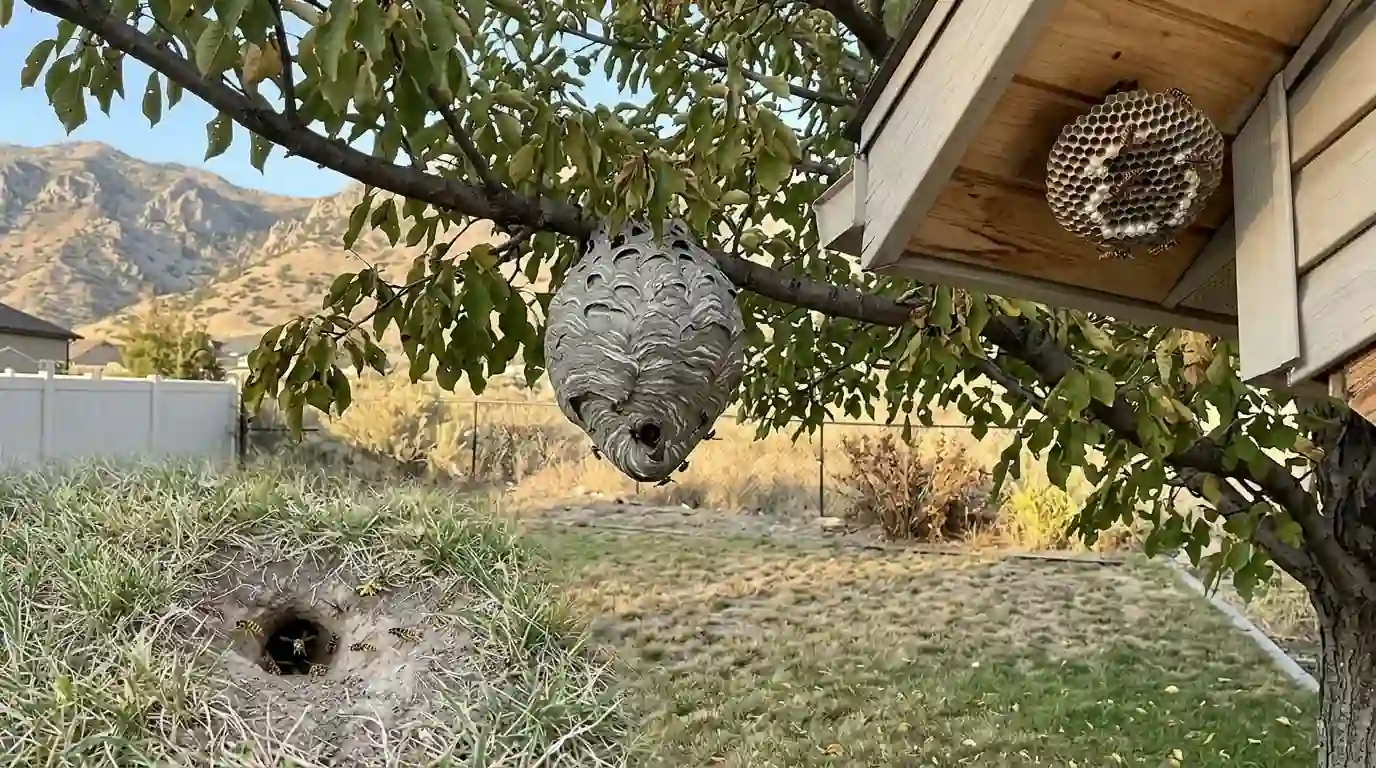
In Utah, paper wasps build open, umbrella-shaped nests under eaves and railings, bald-faced hornets hang enclosed gray paper nests in trees and sheds, and yellowjackets usually nest in shallow holes in the ground. Nests grow all summer and peak in late summer. Leave nests far from people alone; call about any nest by a door, a play area or inside a wall.
Paper wasps
Paper wasps build open, single-comb nests where you can see the cells, under eaves, deck railings, porch lights and play sets. They're usually less aggressive than yellowjackets but will defend a nest near a doorway.
Bald-faced hornets
Bald-faced hornets build enclosed gray paper nests, often football-sized, hanging from branches, shrubs, sheds and eaves. Colonies can be large and defensive, so these are best left to a professional when they're near people.
Yellowjackets
Yellowjackets hide their nests, usually in shallow chambers in the ground or inside wall voids. You don't see them until someone mows over the entrance, which is why they cause so many multiple-sting calls in August and September.
Which nests to leave alone
Nests aren't all bad; wasps eat a lot of garden pests. A small nest high in a tree at the back of the lot can be left. The ones to deal with are near entries, decks, play areas, paths and anywhere someone with a sting allergy spends time.
- Leave: high in trees, far from paths
- Call: by doors, decks and play sets
- Call: in the ground along paths or lawns you mow
- Call: in walls, soffits or attics
Wild About Utah describes bald-faced hornets hanging gray paper nests in tree branches, yellowjackets usually building in shallow underground chambers, and Polistes paper wasps found statewide. USU Extension adds a useful detail for traps: fruit-juice baits work for European paper wasps in mid to late summer, while yellowjackets respond to heptyl butyrate lures, so a trap baited for the wrong insect catches very little. Traps thin foragers around a patio; they don't remove a nest.
Stings and allergies
Most stings cause local pain and swelling. Seek emergency care for trouble breathing, swelling of the face or throat, or dizziness. Anyone with a known allergy should stay well away from nests and removals.
Sources
Late summer, from late July into September.
They thin foragers if baited for the right species, but they don't remove a nest.
Small, early paper wasp nests can be manageable; anything near doors, overhead or in walls is safer handled by a professional.
Colonies are at their largest and foraging hard for food.
No, but queens often build new nests in the same sheltered spots.
Get medical help if there's swelling beyond the sting, trouble breathing or dizziness.
Keep reading
More from the Pest Library
West Nile season in Salt Lake County: a homeowner's checklist
Standing water, timing and what the abatement districts do and don't cover.
Read the articlePest LibraryHobo spider or black widow? Telling Utah house spiders apart
Which spider in the window well actually matters, and what to do about each.
Read the articlePest LibraryWhat pest control costs in Salt Lake City
Published price ranges for common jobs, and what moves a quote up or down.
Read the articleTalk to us
A nest by the door?
Call now. A real person answers any hour and tells you what to do first.
Homes, rentals and businesses across Salt Lake, Davis, Weber, Box Elder, Morgan, Tooele and Utah counties.
